
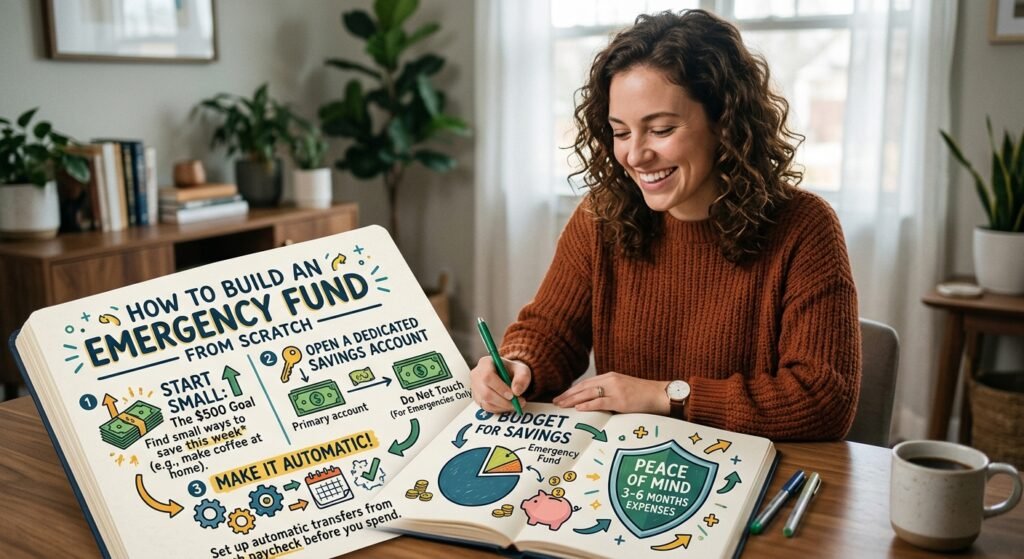
How to Build an Emergency Fund From Scratch: A Complete Guide
Unexpected expenses can happen when you least expect them. A car may suddenly need repairs, a major appliance may stop working, an unexpected medical expense may appear, or your income could temporarily decrease. Without savings, even a relatively small financial shock can put pressure on your monthly budget and may force you to rely on credit cards, loans, or money intended for other goals. An emergency fund is designed to provide a financial cushion for these situations. The Consumer Financial Protection Bureau describes an emergency fund as money specifically set aside for unplanned expenses and financial emergencies such as car repairs, home repairs, medical bills, or loss of income.
The good news is that you do not need to have a large amount of money to begin. Building an emergency fund is a process, and the first goal should be creating the habit of saving consistently. Even small contributions can gradually create a useful financial safety net. In this guide, we will explain how to build an emergency fund from scratch, how much you may want to save, where to keep the money, how to save when your budget is tight, and how to rebuild your fund after using it.
What Is an Emergency Fund?
An emergency fund is a dedicated amount of money reserved for unexpected financial situations. Unlike money saved for a vacation, entertainment, a new phone, or a planned purchase, emergency savings are intended for expenses that are unexpected and difficult to postpone. Examples can include an urgent car repair, an unexpected medical bill, a necessary home repair, or a temporary loss of income. The purpose is to give you access to money when something happens that is outside your normal monthly budget.
An emergency fund can also help separate unexpected expenses from everyday spending. If you keep emergency savings in the same account you use for groceries, shopping, entertainment, and bills, it can be easier to spend that money accidentally. A separate savings account can create a psychological and practical barrier between money intended for emergencies and money available for regular purchases.
The size of an emergency fund will depend on your personal circumstances. Your income, monthly expenses, job stability, family responsibilities, debt, insurance coverage, and other financial commitments can all affect how much savings may be appropriate. There is no single emergency fund amount that works for everyone, so the best approach is to establish an initial goal and increase it as your financial situation improves.
Why Is an Emergency Fund Important?
One of the biggest benefits of an emergency fund is that it can help you respond to financial surprises without immediately turning to borrowing. When an unexpected expense arrives and there is no money available, a person may consider using a credit card, personal loan, or another form of credit. Depending on the product and terms, borrowing can add interest and fees to the original expense.
Emergency savings can therefore act as a financial buffer. The CFPB notes that having money set aside for unexpected expenses can help people recover from financial shocks and potentially reduce reliance on credit or loans.
An emergency fund can also make your overall financial plan more stable. Imagine that you are saving for retirement, paying down debt, or working toward another major financial goal. If an unexpected $1,000 expense occurs and you have no emergency savings, you may have to stop those plans temporarily. Having a dedicated reserve can make it easier to handle the immediate problem while continuing to work toward longer-term objectives.
Start With a Small Emergency Fund Goal
One common mistake is believing that you need thousands of dollars before your emergency fund becomes useful. This mindset can make saving feel impossible, especially if your income is limited or your monthly expenses are already high.
Instead, start with a smaller target. Your first objective might be to save $250, $500, or $1,000, depending on your circumstances. The CFPB has previously provided examples of starting with $500 and then increasing the goal to $1,000, while also emphasizing that the appropriate amount varies from person to person.
The important point is not to treat the first target as the final destination. Think of it as the foundation of your emergency savings plan. Once you reach your initial goal, you can continue building the fund toward a larger amount.
For example, someone starting with $0 might create the following progression:
Stage 1: Save the first $250.
Stage 2: Increase savings to $500.
Stage 3: Reach $1,000.
Stage 4: Build enough savings to cover several months of essential expenses if appropriate for your circumstances.
Breaking a large goal into smaller milestones can make the process feel much more achievable.
Calculate Your Essential Monthly Expenses
After creating your first savings target, take a closer look at your monthly expenses. Your emergency fund should eventually reflect your personal financial situation rather than an arbitrary number.
Start by identifying essential expenses such as housing, utilities, groceries, transportation, insurance, minimum debt payments, and other necessary costs. Review your spending over several months if possible because some expenses occur less frequently than once a month. The CFPB recommends reviewing spending carefully and accounting for less frequent expenses when creating a realistic budget.
Suppose your essential monthly expenses are approximately $2,500. You could eventually decide that having several months of essential expenses saved would provide a stronger financial cushion than simply maintaining a $1,000 balance.
However, do not allow the size of the long-term goal to stop you from starting. Someone with $0 saved should focus first on creating the savings habit.
Create a Monthly Savings Goal
Once you know your initial emergency fund target, decide how much you can realistically save each month.
For example, if your goal is $1,000 and you can save $100 per month, reaching the goal would take approximately ten months. If you can save $200 per month, it would take approximately five months.
Your contribution does not have to be identical every month. If your income changes, your savings amount can change as well. What matters is creating a system that you can maintain without causing problems with essential bills.
A realistic $50 monthly savings habit is generally more useful than setting an unrealistic $500 target and abandoning the plan after one or two months.
Make Emergency Savings Automatic
One of the easiest ways to build an emergency fund is to automate your savings. Instead of waiting until the end of the month to see what money remains, arrange for a specific amount to move into savings automatically.
For example, you could schedule a recurring transfer after receiving your paycheck. You might choose $25, $50, $100, or another amount that fits your budget.
The CFPB identifies automatic recurring transfers as one practical way to create consistent savings habits. It also recommends paying attention to your account balance so an automatic transfer does not result in overdraft fees.
Automation works because it reduces the number of decisions you need to make. Instead of repeatedly asking yourself whether you should save money, your financial system does part of the work for you.
Look for Areas Where You Can Reduce Spending
Building an emergency fund does not necessarily require eliminating everything you enjoy. Instead, look for spending categories where small reductions can create additional savings.
Start by reviewing subscriptions, restaurant spending, food delivery, entertainment, impulse purchases, shopping, and other flexible expenses. You may discover that some recurring expenses provide little value compared with their cost.
For example, reducing spending by $25 on subscriptions and $50 on unnecessary food purchases could potentially create an additional $75 per month for your emergency fund.
The goal is not to make your lifestyle miserable. The goal is to identify spending that does not contribute significantly to your priorities and redirect part of that money toward financial security.
Use One-Time Money to Boost Your Emergency Fund
Regular monthly savings are important, but one-time financial opportunities can help you build an emergency fund faster.
Depending on your circumstances, these opportunities could include a tax refund, cash gift, work bonus, freelance income, sale of unwanted items, or another unexpected payment. Instead of automatically spending all of the extra money, consider directing some or all of it toward emergency savings.
The CFPB specifically recommends considering one-time opportunities, such as tax refunds or cash gifts, as ways to increase emergency savings.
You do not necessarily need to put every extra dollar into savings. A balanced approach may allow you to enjoy part of the money while using another portion to strengthen your financial safety net.
Find Ways to Increase Your Income
Reducing expenses is only one side of the equation. Increasing income can also make it easier to build an emergency fund.
Depending on your skills and situation, additional income might come from freelance work, overtime, selling unused items, part-time work, online services, or other legitimate opportunities.
Consider creating a simple rule for additional income. For example, you could decide that a portion of every extra payment goes directly toward emergency savings.
This approach can help you increase your savings without dramatically changing your normal monthly lifestyle.
Keep Your Emergency Fund Separate
Your emergency fund should be accessible when you genuinely need it, but it should not be so convenient that you constantly spend it.
A separate savings account can help accomplish this. You can keep your everyday spending money in your checking account while maintaining emergency savings somewhere specifically designated for financial emergencies.
The CFPB suggests keeping emergency savings in a place that is safe and accessible while reducing the temptation to spend it on non-emergency purchases.
When selecting an account, consider factors such as accessibility, fees, withdrawal rules, and whether the account is appropriate for your needs. If you are in the United States, you should also understand whether the bank or credit union account you use has applicable deposit insurance protections.
Decide What Counts as an Emergency
One of the most important steps in building an emergency fund is establishing rules for when you will use it.
Without clear guidelines, it can be tempting to treat emergency savings as a general-purpose spending account. A sale, vacation, new electronic device, or routine shopping trip usually should not automatically qualify as an emergency.
A genuine emergency could include an unexpected essential repair, an urgent medical expense, or a significant interruption to your income. The exact definition will depend on your circumstances.
The CFPB recommends setting guidelines for what constitutes an emergency while also emphasizing that you should not be afraid to use the money when a genuine need arises.
Your emergency fund exists to be used when necessary. The goal is not to protect the account balance at all costs. The goal is to create financial protection when unexpected circumstances occur.
Build an Emergency Fund While Paying Debt
People often wonder whether they should save for emergencies or focus entirely on paying debt. The answer depends on the type of debt, interest costs, income stability, and personal circumstances.
Having at least some emergency savings can provide a buffer against unexpected expenses. Without any savings, even a relatively small financial problem could potentially result in additional borrowing.
At the same time, high-interest debt can be expensive, so you may want to balance emergency savings with debt repayment rather than completely ignoring one goal.
For example, you might establish a small starter emergency fund while aggressively addressing expensive debt. After the debt situation improves, you could increase your emergency savings contributions.
The right balance depends on your financial situation, but maintaining some liquidity can help you avoid having every unexpected expense become a new debt problem.
Save Even If You Live Paycheck to Paycheck
Saving money can feel especially difficult when most of your income is already committed to bills and essential expenses. If you are living paycheck to paycheck, the answer is not necessarily to create an unrealistic savings target.
Start extremely small if necessary.
Saving $5, $10, or $20 consistently can help establish the habit. You can increase the amount later when your income rises or expenses decrease.
The CFPB notes that even people with limited ability to save can benefit from putting money aside and developing a consistent savings habit.
You can also look at your cash flow rather than only your monthly totals. The timing of income and expenses may reveal certain periods when you have slightly more available money. Those opportunities can be used to make additional savings contributions.
Use a Separate Savings Goal
It can be helpful to give your emergency fund a specific name and purpose. Instead of simply seeing an account balance, think of it as your “Emergency Fund” or “Financial Safety Fund.”
This creates a clear psychological connection between the money and its purpose.
You can also track progress toward milestones such as $250, $500, $1,000, and eventually a larger target based on your essential expenses.
Watching your balance increase can provide motivation to continue.
Avoid Using Your Emergency Fund for Planned Expenses
Not every large expense is an emergency.
If you know that your car insurance payment is due every six months, that expense can be planned for. If you expect holiday shopping every December, that is also predictable. These expenses should ideally have their own savings categories rather than being funded from your emergency reserve.
This is one reason a broader savings plan can be useful. You might have separate categories for:
Emergency savings: Unexpected financial problems.
Car savings: Maintenance and predictable repairs.
Holiday savings: Gifts and seasonal spending.
Vacation savings: Planned travel.
Home savings: Planned maintenance and improvements.
Separating these goals helps preserve your emergency fund for situations that genuinely require it.
Rebuild Your Emergency Fund After Using It
Using your emergency fund does not mean that you failed. In fact, using the money for a legitimate emergency is one of the reasons you built the fund in the first place.
Suppose you have saved $3,000 and then need $1,200 for an unexpected essential expense. Your emergency fund falls to $1,800.
Once the immediate problem has been handled, return to your savings routine. You can temporarily increase contributions if your budget allows, or simply continue with your normal monthly amount.
The important thing is to treat rebuilding as a normal part of financial planning. The CFPB specifically advises consumers to work toward rebuilding emergency savings after using the money.
Review Your Emergency Fund Every Few Months
Your emergency fund should change as your life changes.
A savings amount that was appropriate when you had low expenses may not be enough after buying a home, having children, changing jobs, taking on additional responsibilities, or experiencing a significant income change.
Review your emergency savings periodically and compare it with your current essential expenses.
You should also review your budget to identify changes in rent, utilities, insurance, debt payments, transportation, groceries, and other major costs.
Regular reviews help keep your emergency fund connected to your current financial reality.
Common Emergency Fund Mistakes to Avoid
One common mistake is waiting until you can save a large amount before starting. This delays the development of the savings habit.
Another mistake is keeping emergency savings in an account that is too easy to spend from. If your emergency fund is mixed with everyday spending money, it may gradually disappear.
A third mistake is setting an unrealistic monthly target. Saving aggressively for a few weeks and then stopping completely is less sustainable than creating a manageable routine.
Another mistake is never using the fund even when a genuine emergency occurs. The purpose of emergency savings is financial protection. If you have a legitimate unexpected expense, using the money can prevent the need for more expensive borrowing.
Finally, avoid treating every planned purchase as an emergency. Building separate savings categories for predictable expenses can protect your emergency reserve.
A Simple Emergency Fund Plan for Beginners
If you are starting from $0, you can follow a straightforward process.
First, review your current income and expenses. Understand where your money is going each month.
Second, open or designate a separate savings account for emergency savings.
Third, choose a small initial target such as $250 or $500.
Fourth, select a monthly amount that you can realistically afford.
Fifth, automate the contribution whenever possible.
Sixth, look for unnecessary expenses that can be redirected toward savings.
Seventh, use one-time income opportunities to accelerate your progress.
Eighth, increase your target after reaching your first milestone.
Ninth, establish clear rules for what qualifies as an emergency.
Finally, review and rebuild your fund whenever you use it.
This process turns emergency savings from an abstract financial goal into a practical monthly habit.
Final Thoughts on Building an Emergency Fund From Scratch
Learning how to build an emergency fund from scratch is one of the most practical steps you can take toward stronger money management. You do not need a perfect budget, a high income, or thousands of dollars in the bank before getting started. What matters most is creating a realistic system that allows you to save consistently.
Start with a small goal, automate what you can, review your spending, use occasional extra income wisely, and gradually increase your savings target. Even small contributions can add up over time, and having dedicated money available for unexpected expenses can provide an important financial cushion. The CFPB emphasizes that saving even small amounts can help people prepare for financial shocks and develop stronger savings habits.
An emergency fund should be viewed as part of a larger financial plan. Once you establish a savings habit, you can continue working toward other goals such as paying down debt, saving for major purchases, investing for the future, and preparing for retirement. The most important step is simply to begin.
Internal Linking Suggestions for Gaming Era:
- Link to Smart Money Management Tips to Take Control of Your Finances when discussing overall money management habits.
- Link to How to Create a Monthly Budget That Actually Works when explaining how to find money for emergency savings.
- Link to 50/30/20 Budget Rule Explained: How to Manage Your Money Better when discussing how to divide monthly income.
- Link to How to Stop Overspending and Save More Money Every Month when discussing ways to reduce expenses and increase savings.