
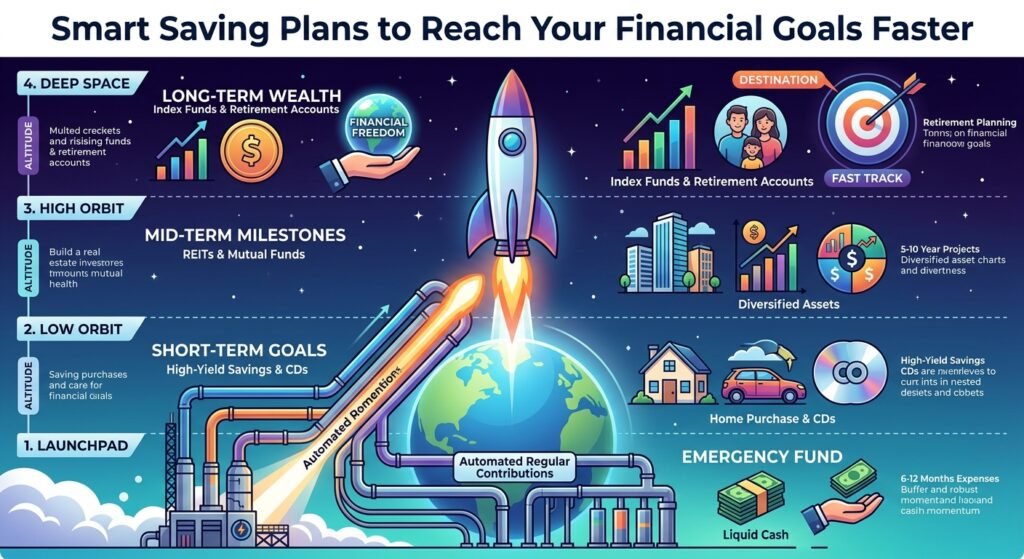
Smart Saving Plans to Reach Your Financial Goals Faster
Achieving financial goals requires more than simply earning money. It requires a clear plan, consistent saving, responsible spending, and the ability to make informed financial decisions. Whether your goal is to build an emergency fund, buy a home, pay for education, purchase a car, start a business, travel, or prepare for retirement, a smart saving plan can help you move toward your target more efficiently.
Many people want to save money but struggle because they do not have a clear strategy. They may save whatever is left at the end of the month, spend without tracking their expenses, or set goals that are difficult to measure. A smart saving plan changes this approach by giving every saved amount a purpose.
The goal of smart saving is not necessarily to stop spending money altogether. Instead, it is about using your income intentionally. By understanding your financial situation, setting specific goals, automating savings, reducing unnecessary expenses, and choosing appropriate financial products, you can improve your ability to reach your financial goals.
This guide explains smart saving plans to reach your financial goals faster, with practical strategies that beginners and experienced savers can use to build better financial habits.
What Is a Smart Saving Plan?
A smart saving plan is a structured approach to managing income and setting aside money for specific financial goals. It combines budgeting, regular contributions, goal setting, expense management, and appropriate financial products.
A basic saving plan might involve transferring a fixed amount into a savings account every month. A more advanced plan may divide savings among several goals, such as emergency savings, retirement, education, and a home purchase.
The most important feature of a smart saving plan is that it is realistic and measurable. You should know how much you want to save, why you are saving, when you need the money, and how much you need to contribute regularly.
Set Specific Financial Goals
The first step toward faster financial progress is to establish clear goals. Instead of saying that you want to save more money, determine exactly what you want to achieve.
For example, you might decide to save $5,000 for a car within two years or build an emergency fund equal to several months of essential expenses.
Specific goals make saving easier because you can calculate the amount required and monitor your progress.
It is also useful to divide goals into short-term, medium-term, and long-term categories. Short-term goals may take several months or a few years, while long-term goals can take many years.
Calculate How Much You Need to Save
Once you have a financial goal, calculate how much you need to save regularly.
Suppose your goal is to save $12,000 within two years. Dividing the target by 24 months gives a basic monthly savings target of $500, before considering any interest or investment returns.
This calculation allows you to compare your goal with your current income and expenses.
If the required contribution is too high, you have several options. You could extend the deadline, reduce the target, increase your income, reduce expenses, or combine several of these strategies.
Having a specific number makes your saving plan much easier to manage.
Create a Detailed Monthly Budget
A budget is one of the most important tools for smart saving. It shows where your money goes and helps you identify opportunities to increase your savings.
Start by listing your monthly income and fixed expenses. Then add variable expenses such as groceries, transportation, entertainment, shopping, subscriptions, and dining out.
Once everything is listed, examine which expenses are essential and which can be reduced.
A budget should not be so restrictive that it becomes impossible to maintain. A realistic plan should allow you to meet essential expenses while still leaving room for personal spending.
Pay Yourself First
One of the most effective saving strategies is to pay yourself first. This means putting money into savings before spending on non-essential items.
For example, when you receive your salary, you can immediately transfer a predetermined amount to your savings account.
If you wait until the end of the month, you may spend the money that you intended to save. Paying yourself first makes savings a priority rather than an afterthought.
Even a modest automatic contribution can become significant when repeated consistently.
Automate Your Savings
Automation is one of the simplest ways to make saving consistent. Most banks allow customers to schedule automatic transfers between accounts.
You can arrange for money to move into your savings account shortly after your salary arrives.
For example, if your monthly savings target is $300, an automatic transfer can move that amount every month without requiring you to remember.
Automation reduces the temptation to spend money before saving it and helps turn saving into a financial habit.
Use Separate Accounts for Different Goals
Keeping all your savings in one account can make it difficult to know what your money is intended for.
Consider separating your savings into different categories. You might have an emergency fund, home savings, education savings, vacation savings, and retirement savings.
Separate accounts or digital savings categories can help you track progress toward each goal.
When your money has a clear purpose, you may also be less likely to spend it on unrelated purchases.
Build an Emergency Fund
An emergency fund is an important part of a smart financial plan. It provides money for unexpected expenses and can reduce the need to rely on high-cost borrowing.
Emergency expenses might include medical bills, vehicle repairs, urgent home maintenance, or a temporary reduction in income.
The amount you need depends on your circumstances. Factors such as income stability, employment, family responsibilities, debt, and monthly expenses can affect the appropriate emergency fund size.
Emergency savings should generally be kept in a relatively safe and accessible place.
Reduce Unnecessary Expenses
One of the fastest ways to increase your savings is to identify unnecessary spending.
Review recurring expenses such as streaming services, memberships, food delivery, frequent restaurant meals, online shopping, and other discretionary purchases.
You do not have to eliminate every enjoyable activity. Instead, focus on expenses that provide limited value or that you can reduce without significantly affecting your lifestyle.
For example, reducing several small monthly expenses could free up money for your savings goal.
Use the 24-Hour Rule
Impulse purchases can slow down financial progress. A simple strategy for controlling unnecessary spending is to wait before buying non-essential items.
For smaller purchases, consider waiting 24 hours. For expensive purchases, you may want to wait several days.
During this time, ask yourself whether you genuinely need the item, whether it fits your budget, and whether purchasing it will delay an important financial goal.
This short pause can prevent many unnecessary purchases.
Save Unexpected Income
Unexpected income can provide an opportunity to accelerate your financial goals.
Additional money may come from bonuses, gifts, refunds, freelance work, overtime, or other sources.
You do not necessarily need to save all of it. Instead, decide in advance how you will divide unexpected income between savings, debt repayment, and personal spending.
Directing a portion toward your financial goals can help you make faster progress without increasing your regular monthly savings requirement.
Increase Your Savings When Your Income Rises
A salary increase can provide an excellent opportunity to increase your savings.
Instead of immediately increasing your lifestyle expenses, consider directing a portion of the additional income toward savings.
For example