
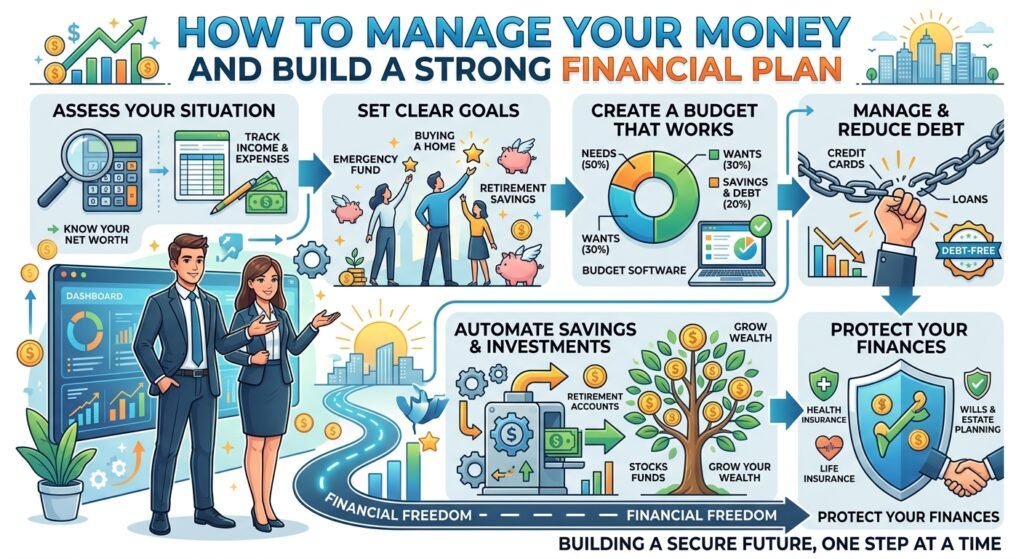
How to Manage Your Money and Build a Strong Financial Plan
Introduction
Learning how to manage your money is one of the most important steps toward creating greater financial stability. Whether you are just starting your career, supporting a family, paying off debt, saving for a major purchase, or preparing for the future, having a clear financial plan can make your money decisions easier to understand and organize. Good money management is not simply about earning more money. It is about knowing where your money goes, controlling unnecessary expenses, saving consistently, managing debt responsibly, and creating a plan that matches your financial goals.
A strong financial plan gives your money a purpose. Instead of spending your income without a clear direction, you can decide how much should go toward essential expenses, savings, debt payments, future goals, and everyday spending. Consumer.gov explains that a budget can help you compare your income with your expenses and identify opportunities to save or adjust spending.
The good news is that you do not need to completely change your financial life overnight. Strong financial management is built through small, repeatable habits. By understanding your current financial position and creating a realistic plan, you can gradually build better control over your money.
1. Understand Your Current Financial Situation
Before creating a financial plan, you need to understand where you currently stand. Many people try to improve their finances without first looking at their income, expenses, savings, debts, and financial obligations. This makes it difficult to create a realistic plan because you are working with assumptions instead of actual numbers.
Start by writing down all of your sources of income. This may include your regular paycheck, freelance income, business income, side work, or other reliable sources. Then make a complete list of your regular expenses. Include housing, utilities, groceries, transportation, insurance, phone bills, subscriptions, debt payments, entertainment, and other spending.
Your bank statements and recent bills can help you create a more accurate picture. The Consumer Financial Protection Bureau recommends tracking spending and reviewing less frequent expenses as part of building a realistic budget.
Once you have these numbers, calculate the difference between your monthly income and expenses. If your expenses are higher than your income, your first priority should be identifying areas where spending can be reduced or income can be increased. If you have money left over, you can give that money specific jobs such as saving, debt repayment, or long-term financial goals.
2. Create a Realistic Monthly Budget
A monthly budget is the foundation of effective money management. A budget tells your money where to go before you spend it. It can also help you identify unnecessary expenses and make sure that important financial priorities are not forgotten.
Start your budget with your take-home income rather than your gross salary. Your take-home pay is the amount that actually reaches your bank account after applicable deductions.
Next, organize your expenses into categories. Housing, utilities, groceries, transportation, insurance, and debt payments may represent essential expenses. Entertainment, dining out, shopping, subscriptions, hobbies, and other discretionary purchases can be tracked separately.
A useful budget should be realistic. If you create a budget that allows no room for normal enjoyment or unexpected costs, it may become difficult to maintain. The goal is to create a system that you can realistically follow every month.
Consumer.gov recommends creating a monthly plan, tracking actual spending, and using the results to improve the following month’s budget.
3. Separate Needs From Wants
One of the simplest ways to improve money management is to understand the difference between needs and wants. Needs are expenses that are important for basic living and financial obligations, while wants are purchases that improve convenience, entertainment, or lifestyle but may not be essential.
Housing, basic groceries, utilities, transportation required for work, insurance, and necessary medical expenses can generally be considered needs. Restaurant meals, expensive clothing, entertainment subscriptions, upgraded electronics, and frequent impulse purchases may fall into the wants category.
This does not mean you should eliminate all wants. A sustainable financial plan should leave room for enjoyment. Instead, the purpose is to make spending decisions consciously.
Before making a purchase, ask yourself whether the item is necessary, whether it fits within your budget, and whether buying it will interfere with an important financial goal. This simple habit can help reduce unnecessary spending over time.
4. Set Clear Financial Goals
A financial plan becomes much more useful when you know what you are trying to accomplish. Instead of simply saying, “I want to save money,” create specific goals with an amount and a timeframe.
For example, you might want to save $1,000 for an emergency fund, pay off $5,000 of credit card debt, save $10,000 for a major purchase, or increase retirement contributions over time.
The Consumer Financial Protection Bureau provides financial planning tools that encourage consumers to set specific goals, determine how much they need, and calculate how much they need to save over a particular period.
Divide larger goals into smaller monthly targets. If you want to save $2,400 over 12 months, for example, the basic target would be $200 per month. Breaking a large goal into smaller steps makes it easier to measure progress and adjust your budget when necessary.
5. Build an Emergency Fund
An emergency fund is an important part of a strong financial plan because unexpected expenses can disrupt even a carefully prepared budget. Car repairs, home problems, unexpected bills, temporary income interruptions, or other emergencies can create financial pressure.
Start with an amount that is realistic for your current situation. You do not have to build a large savings balance immediately. Even a small initial savings target can provide a financial cushion while you continue working toward larger goals.
Create a separate place for emergency savings so that the money is not easily confused with your everyday spending money. You can then make regular contributions according to your budget.
The CFPB’s financial resources specifically include savings plans designed to help people prepare for unexpected expenses and work toward financial goals.
6. Make Saving Part of Your Budget
Many people save only whatever money happens to remain at the end of the month. The problem is that there may be very little left after everyday expenses.
Instead, include savings as a planned part of your monthly budget. Decide how much you can realistically save and treat that amount as one of your financial priorities.
For example, if your monthly budget allows you to save $200, you can schedule that amount to move into savings after receiving your paycheck. Automatic transfers can make saving more consistent because the money is moved before it becomes available for unnecessary spending.
The CFPB has also highlighted automatic saving as a way to turn financial goals into regular habits.
The exact amount you save will depend on your income, expenses, debt, and financial goals. Consistency is often more important than starting with a large amount.
7. Manage Debt With a Clear Strategy
Debt can make it harder to build financial security because part of your income is already committed to previous purchases or obligations. A strong financial plan should include a clear strategy for managing and reducing debt.
Begin by listing each debt, including the balance, interest rate, minimum payment, and due date. This gives you a complete picture of your obligations.
Continue making required minimum payments while deciding how to direct additional money toward debt. Some people prefer the debt avalanche approach, which prioritizes higher-interest debt first. Others use the debt snowball approach, which focuses on smaller balances first.
There is no need to use a complicated system. The most important thing is to choose a manageable strategy and consistently follow it while avoiding unnecessary new debt.
The CFPB provides tools covering debt logs, debt repayment plans, and strategies for managing debt.
8. Control Your Everyday Spending
Managing your money does not mean only making big financial decisions. Small everyday purchases can also have a significant effect on your monthly budget when they happen repeatedly.
Look at categories such as food delivery, restaurants, subscriptions, online shopping, entertainment, convenience purchases, and impulse spending. You may discover that a few small adjustments can create additional room in your budget.
For example, reducing restaurant spending by $50 per month creates $600 over a year. Reducing several recurring expenses can create even more room for savings or debt repayment.
The goal is not to remove every enjoyable purchase. Instead, identify spending that provides little value to you and redirect some of that money toward goals that matter more.
9. Create a Plan for Irregular Expenses
A common budgeting mistake is planning only for monthly expenses. Many costs do not occur every month but can still have a major impact on your finances.
Examples include annual insurance payments, vehicle maintenance, holiday spending, gifts, travel, school expenses, medical costs, and other occasional purchases.
Review your previous year’s spending and identify expenses that happen less frequently. Then estimate how much you need for them and divide the amount across the months before the expense occurs.
For example, if you expect to spend $600 on annual expenses, setting aside $50 per month can make the eventual payment easier to handle. This approach prevents predictable expenses from being mistaken for emergencies.
The CFPB recommends reviewing several months of spending to account for less frequent expenses when creating a realistic budget.
10. Keep Your Bills Organized
Late payments can create unnecessary financial stress and may lead to fees or other consequences. A strong financial plan should include a system for keeping track of bills and payment dates.
Create a bill calendar showing when each major payment is due. You can also use calendar reminders or automatic payments where appropriate.
Organize bills by due date and make sure your checking account has enough money available when payments are scheduled.
If your income arrives on different dates throughout the month, a cash-flow budget can help you understand when money comes in and when it needs to go out. This can be particularly useful for people who have irregular income or several large bills concentrated around certain dates.
11. Avoid Lifestyle Inflation
As your income increases, it can be tempting to immediately increase your spending. This is often called lifestyle inflation.
For example, someone may receive a raise and quickly upgrade their car, move into a more expensive home, increase restaurant spending, and purchase more expensive entertainment. The higher income may feel like it has disappeared even though the person earns more.
Instead, consider directing part of every income increase toward financial goals. You can still improve your lifestyle, but you do not have to increase every expense at the same rate as your income.
This can create a stronger financial foundation over time and give you more flexibility when unexpected expenses occur.
12. Build a Debt-Free and Savings-Focused Routine
A strong financial plan should become a routine rather than a document that you create once and forget.
Set aside a few minutes each week to review your recent spending. Then perform a more detailed financial review at the end of every month.
During your monthly review, compare your planned spending with actual spending. Check whether you reached your savings target, whether you paid bills on time, whether debt balances changed, and whether any expenses need to be adjusted.
The CFPB recommends reviewing real-life financial results against your plan and making adjustments when circumstances or spending patterns change.
This process turns financial planning into an ongoing habit.
13. Increase Your Income When Possible
Reducing expenses is only one side of money management. Increasing income can also improve your financial position.
Depending on your circumstances, you might explore opportunities for overtime, freelance work, part-time work, selling unused items, developing a professional skill, or pursuing opportunities for career advancement.
Extra income can be directed toward specific goals instead of automatically becoming additional spending money.
For example, you could decide that a portion of additional income will go toward debt repayment while another portion goes toward savings. Having a plan before receiving extra money can help prevent it from disappearing into unnecessary purchases.
14. Protect Your Financial Progress
Building wealth and financial stability is not only about saving money. It is also about protecting what you have built.
Review your insurance coverage, keep important financial documents organized, monitor your accounts, and pay attention to suspicious financial activity. Be careful with financial products, investments, loans, and offers that promise unusually high returns or guaranteed results.
Before making a major financial decision, research the costs, risks, terms, and alternatives. Avoid making financial decisions simply because someone else recommends them.
Your financial plan should be based on your own goals, income, expenses, risk tolerance, and time horizon.
15. Review and Update Your Financial Plan
Your financial plan should change as your life changes. A plan that works when you are single and starting your career may need to change after getting married, buying a home, starting a family, changing jobs, or approaching retirement.
Review your financial plan at least once every few months and whenever there is a major change in your income or expenses.
Ask yourself several basic questions: Is my budget still realistic? Am I saving enough for my current goals? Has my debt changed? Have my priorities changed? Are there expenses I can reduce? Do I need to create a new savings goal?
Regular reviews allow you to make smaller adjustments instead of waiting until a financial problem becomes serious.
16. Create a Simple Financial Plan You Can Follow
A financial plan does not have to be complicated. A simple plan can be highly effective if you actually follow it.
Your basic plan can include five major areas: monthly expenses, savings, debt repayment, financial goals, and future planning.
For example, imagine someone brings home $4,000 per month. They could first calculate essential expenses, then allocate money for savings and debt repayment, while keeping a reasonable amount available for discretionary spending. If the person’s income or expenses change, the plan can be adjusted.
The important part is that every dollar has a purpose. Instead of asking where your money went at the end of the month, you should have a clear idea of where it is supposed to go at the beginning.
17. Use Financial Tools to Stay Organized
Technology can make money management easier. Budgeting apps, spreadsheets, banking tools, automatic transfers, calendar reminders, and account alerts can all help you monitor your financial activity.
However, you do not need an expensive application to manage your finances. A simple spreadsheet or notebook can work if it allows you to track income, expenses, savings, and debt.
The best financial system is one that you can understand and use consistently. A complicated system that you stop using is less useful than a simple system that you review every week.
18. Avoid Trying to Fix Everything at Once
One of the biggest mistakes people make when improving their finances is trying to change everything immediately. They create an extremely restrictive budget, attempt to eliminate all unnecessary spending, aggressively repay debt, save a large amount, and completely change their lifestyle at the same time.
This approach can be difficult to maintain.
Instead, choose a few priorities. You might begin by tracking your spending, creating a monthly budget, building a small emergency fund, and developing a debt repayment strategy.
Once those habits become normal, you can add additional goals. Financial progress is usually easier to maintain when it is built gradually.
19. Build a Long-Term Financial Mindset
Managing money successfully is not about being perfect. It is about making informed decisions consistently over time.
There will be months when expenses are higher than expected. You may occasionally overspend or have to use savings for an unexpected expense. These situations do not mean your financial plan has failed.
The important thing is to review what happened, make adjustments, and continue moving forward.
The CFPB emphasizes that financial goals and personal financial rules should be practical and adaptable to individual circumstances rather than treated as identical requirements for everyone.
Your financial plan should support your life rather than make everyday life unnecessarily difficult.
20. A Simple Step-by-Step Money Management Plan
If you are not sure where to begin, follow this simple process.
Step 1: Calculate your monthly take-home income.
Step 2: Track your spending and list all regular expenses.
Step 3: Separate essential expenses from discretionary spending.
Step 4: Create a realistic monthly budget.
Step 5: Set specific short-term and long-term financial goals.
Step 6: Start building an emergency savings fund.
Step 7: List your debts and choose a repayment strategy.
Step 8: Automate regular savings when practical.
Step 9: Reduce unnecessary recurring expenses.
Step 10: Review your financial progress every month.
Step 11: Adjust your budget when your income, expenses, or goals change.
Step 12: Continue improving your financial habits over time.
This process provides a basic structure that can be adapted to different income levels and financial situations.
Common Money Management Mistakes to Avoid
Several mistakes can make financial planning more difficult. One common mistake is creating a budget based on ideal spending rather than actual spending. Another is forgetting irregular expenses and then treating predictable costs as emergencies.
Ignoring high-interest debt can also slow financial progress, especially when balances continue growing. Spending increases immediately after receiving a raise can make it harder to build savings. Another common problem is setting vague goals without specific amounts or deadlines.
It is also important to avoid comparing your financial life with other people’s lifestyles. Someone else’s car, home, vacation, or shopping habits do not tell you anything about their income, savings, debt, or financial obligations.
Focus on building a financial plan that fits your own circumstances.
How Long Does It Take to Improve Your Finances?
There is no universal timeline for improving your financial situation. Some changes can produce results within a few weeks, while larger goals may take years.
Creating a budget can immediately give you a clearer understanding of your spending. Reducing unnecessary expenses can free up money within a month. Building an emergency fund may take several months or longer. Paying off significant debt can take years depending on the balance, interest rates, income, and repayment amount.
The important thing is to measure progress rather than expecting an overnight transformation.
Even small improvements can become meaningful when repeated consistently.
Final Thoughts
Learning how to manage your money and build a strong financial plan is a long-term process. The foundation starts with understanding your income and expenses, creating a realistic budget, controlling unnecessary spending, building savings, managing debt, and setting clear financial goals.
A strong financial plan should be practical and flexible. Your income, expenses, responsibilities, and priorities can change, so your plan should change with them. Regularly reviewing your finances helps you identify problems early and make adjustments before they become larger challenges.
Start with the basics. Track your money, create a budget, set realistic goals, save consistently, manage debt carefully, and review your progress each month. Over time, these simple habits can create a more organized and purposeful approach to personal finance.
Remember that effective money management is not about following one perfect formula. It is about creating a system that helps you make better financial decisions and work toward the goals that matter to you. Consumer.gov and the CFPB both provide budgeting, savings, spending, and financial-goal resources that can help consumers develop and maintain practical money-management systems.
Suggested Internal Links for Gaming Era
You can internally link this article to your existing Money Management articles:
- Smart Money Management Tips to Take Control of Your Finances
- How to Create a Monthly Budget That Actually Works
- 50/30/20 Budget Rule Explained
- How to Stop Overspending and Save More Money Every Month
- How to Build an Emergency Fund From Scratch
- Best Ways to Save Money on Everyday Expenses
- How to Manage Your Money When Living Paycheck to Paycheck
- Debt Management Strategies: How to Pay Off Debt Faster
- Best Money Management Habits That Can Improve Your Finances
Conclusion
A strong financial plan gives your money direction. By combining budgeting, saving, debt management, financial goals, and regular reviews, you can create a money-management system that is easier to understand and maintain. Start with one step today, keep your plan realistic, and improve it as your financial situation changes.