
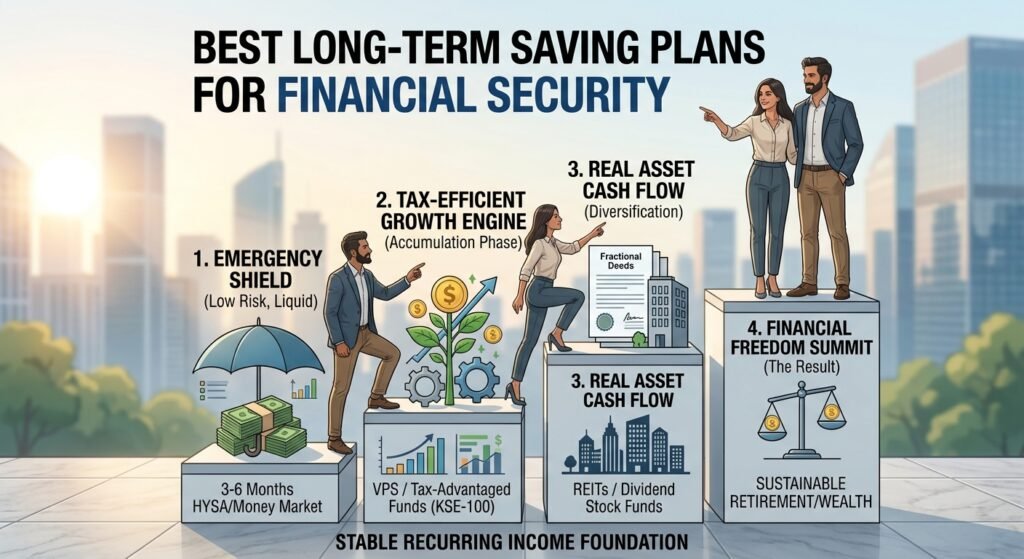
Best Long-Term Saving Plans for Financial Security
Financial security is one of the most important goals for individuals and families who want to build a stable and comfortable future. Whether you are planning for retirement, buying a home, paying for education, starting a business, or simply creating a financial cushion for the future, long-term saving can help you prepare for major expenses and unexpected situations. Unlike short-term saving, long-term financial planning focuses on goals that may take several years or even decades to achieve.
Choosing the best long-term saving plans for financial security requires careful consideration of your financial goals, income, expenses, time horizon, risk tolerance, inflation, and expected returns. There is no single saving plan that is suitable for everyone. The right strategy depends on your individual circumstances and the purpose for which you are saving.
Long-term saving is not simply about putting money into an account and forgetting about it. It involves creating a realistic financial plan, contributing consistently, reviewing your progress, and making adjustments when your circumstances change. With patience and discipline, regular contributions can potentially grow significantly over time, particularly when interest or investment returns are reinvested.
This guide explores some of the most common long-term saving plans and strategies, explains how they work, and provides practical tips for creating a financial plan that can support long-term financial security.
What Is a Long-Term Saving Plan?
A long-term saving plan is a structured strategy for setting aside money for financial goals that are several years away or longer. Examples include retirement, purchasing property, funding education, building a business, or creating long-term wealth.
Long-term savings can be held in different financial products depending on your country and financial institution. These may include savings accounts, fixed-term deposits, retirement accounts, bonds, mutual funds, exchange-traded funds, and other investment products.
The purpose of a long-term plan is to provide a systematic approach to building financial resources over time. Instead of relying on a large amount of money becoming available in the future, you gradually build your financial resources through regular contributions.
Why Long-Term Saving Is Important
Long-term saving can provide greater financial stability and flexibility. Many major financial goals require significant amounts of money, making it difficult to achieve them through short-term saving alone.
For example, retirement can last for many years, so preparing financially may require decades of planning. Similarly, purchasing a home or paying for higher education may require years of preparation.
Long-term saving also provides more time for your money to potentially benefit from compound growth. When earnings remain invested or deposited, future earnings may be generated on both the original contributions and accumulated earnings.
Time can therefore become an important part of a financial strategy. Starting earlier may allow you to spread contributions over a longer period.
1. Retirement Savings Plans
Retirement saving is one of the most important long-term financial goals. Depending on your country, retirement savings may involve employer-sponsored pension plans, individual retirement accounts, provident funds, or other retirement products.
The basic idea is to contribute money during your working years so that you have financial resources available after you stop working.
Retirement saving is generally a long-term process. Even relatively small regular contributions can accumulate over many years. If your employer offers a retirement contribution or matching arrangement, understanding the rules can also be important.
When selecting a retirement plan, consider contribution limits, fees, tax treatment, withdrawal rules, investment choices, and the time remaining until retirement.
2. Fixed-Term Savings and Deposits
Fixed-term deposits can be an option for people who prefer predictable returns and want to keep money invested for a specific period. Depending on the financial institution and country, these products may have different names and conditions.
With a fixed-term deposit, you generally agree to keep money deposited for a specified period. In exchange, the institution may provide a predetermined interest rate or return according to the product terms.
Fixed-term products can provide greater predictability than investments whose value changes with financial markets. However, they may also have restrictions on early withdrawals.
Before choosing a fixed-term deposit, compare the interest rate, maturity period, minimum deposit, withdrawal penalties, renewal terms, and applicable taxes.
3. High-Yield Savings Accounts
A high-yield savings account may provide a higher interest rate than a basic savings account. This can make it useful for people who want their money to remain relatively accessible while earning interest.
Although these accounts can be useful for long-term savings, the interest rate may change over time. Therefore, it is important to review the rate and account conditions periodically.
High-yield savings accounts may be particularly useful for financial reserves that need to remain accessible. For very long-term goals, however, some people consider a combination of savings and investments depending on their risk tolerance.
4. Bonds and Fixed-Income Investments
Bonds are debt securities issued by governments, corporations, or other entities. When you purchase a bond, you are generally lending money to the issuer in exchange for interest payments and repayment according to the bond’s terms.
Bonds can play a role in long-term financial planning because they may provide income and can behave differently from stocks. However, bonds are not completely risk-free. Their prices can change, and there can be credit, interest-rate, inflation, and other risks.
Government bonds may have different risk characteristics from corporate bonds. Before investing, understand the issuer, maturity, interest payments, credit quality, fees, and tax treatment.
5. Mutual Funds
Mutual funds pool money from multiple investors and invest it in a portfolio of assets according to a specific strategy. A fund may invest in stocks, bonds, or a combination of assets.
Mutual funds can provide diversification because your money may be spread across multiple securities. This can be useful for investors who want exposure to a broader group of assets rather than selecting individual investments themselves.
However, mutual funds have risks and fees. The value of the fund can rise or fall depending on the assets it holds. Investors should review the fund’s objectives, historical performance, expenses, risks, and management strategy before investing.
6. Exchange-Traded Funds
Exchange-traded funds, commonly known as ETFs, are investment funds that trade on financial exchanges. Many ETFs are designed to track a particular market index, sector, commodity, or investment strategy.
Some investors use diversified ETFs as part of long-term investment strategies because they can provide exposure to a broad range of securities through a single investment.
However, ETFs are investments rather than traditional savings accounts. Their prices fluctuate, and investors can lose money. The suitability of an ETF depends on factors such as investment goals, time horizon, risk tolerance, fees, and diversification.
7. Goal-Based Saving Plans
Goal-based saving is a practical approach to long-term financial planning. Instead of simply accumulating money without a specific purpose, you establish a target and deadline.
For example, you may want to save a certain amount for a home down payment within five years. Once you know the target and deadline, you can calculate the approximate monthly or annual contribution required.
Having a specific goal can make long-term saving easier to manage because you can measure your progress.
You can create separate goals for retirement, education, property, travel, business, and other major expenses.
8. Education Savings Plans
Education can be one of the largest financial expenses for families. A dedicated education savings plan can help parents or students prepare for future tuition and other educational costs.
The appropriate strategy depends on when the money will be needed. If education expenses are only a few years away, preserving capital and maintaining access may be important. If the goal is many years away, some people may consider investment-based products.
When choosing an education savings product, review its fees, tax treatment, withdrawal rules, investment options, and restrictions on how the money can be used.
9. Property and Home Savings
Saving for a home is another common long-term financial goal. A home purchase may require a substantial down payment as well as money for closing costs, moving expenses, repairs, and other costs.
Creating a dedicated home savings fund can help you prepare for these expenses.
The timeline for purchasing a property should influence how you manage the money. If you expect to purchase soon, preserving the money may be more important than taking significant investment risk.
For longer-term goals, you may have more flexibility, but you should still consider the possibility that investment values can decline.
10. Diversified Investment Plans
A diversified investment plan combines different types of assets to help spread risk. Depending on the investor’s circumstances, a diversified portfolio may include stocks, bonds, funds, and other investments.
Diversification does not eliminate risk, but it can reduce dependence on the performance of a single investment.
For long-term goals, diversification can be an important part of a broader financial strategy. However, your asset allocation should reflect your time horizon and ability to tolerate fluctuations.
A financial professional may be able to provide personalized guidance if you are uncertain about investment choices.
The Importance of Compound Growth
Compound growth is one of the key reasons long-term saving can be powerful. When your savings generate interest or investment returns and those earnings remain invested, they can generate additional earnings.
Consider a simple example. Suppose you contribute money regularly to an account that generates returns. Over time, your balance may grow from your contributions as well as accumulated earnings.
The effect can become increasingly significant over longer periods. This is why beginning a long-term savings strategy early can provide an advantage.
However, actual returns depend on the financial product, interest rates, market conditions, fees, taxes, and other factors. Investment returns are not guaranteed.
Consider Inflation When Planning for the Future
Inflation reduces the purchasing power of money over time. A certain amount of money today may not buy the same amount of goods and services several years from now.
This makes inflation an important consideration for long-term financial planning.
For example, if you are planning for retirement decades in the future, simply estimating your future expenses using today’s prices may underestimate how much money you will eventually need.
Long-term