
50/30/20 Budget Rule Explained: How to Manage Your Money Better
Managing money can become much easier when you have a simple system to guide your spending. Instead of wondering where your paycheck went at the end of every month, a budgeting method can help you decide in advance how much money should go toward essential expenses, personal spending, savings, and other financial priorities. One popular framework is the 50/30/20 budget rule, which divides your take-home income into three broad categories: needs, wants, and savings or financial goals.
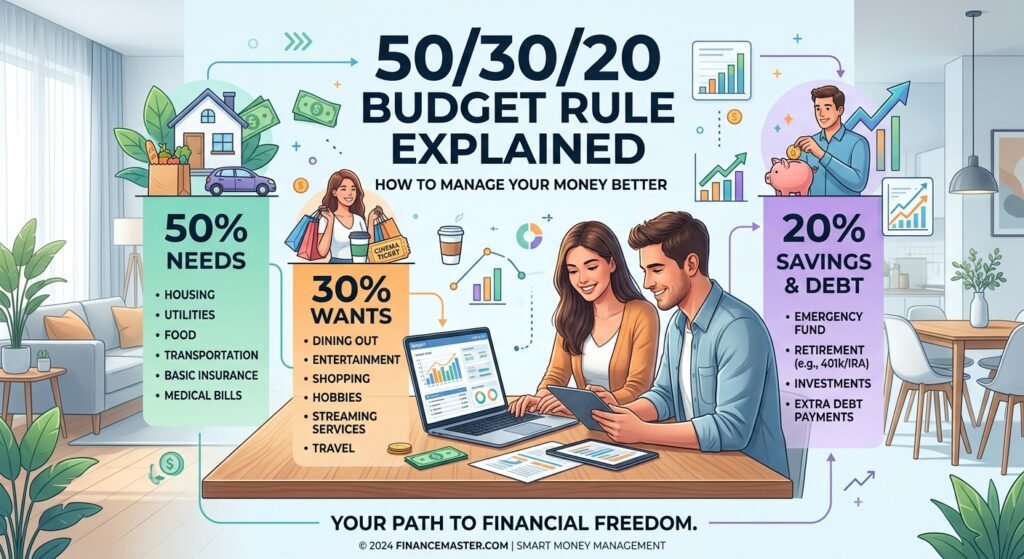
The basic idea is straightforward. Around 50% of your after-tax income is allocated to needs, 30% to wants, and 20% to savings and financial goals. The Consumer Financial Protection Bureau has used this framework as one example of a budgeting rule, while also emphasizing that people should create a personal rule that works for their own financial circumstances.
The 50/30/20 budget rule can be useful because it provides a simple starting point for people who do not know how to organize their monthly spending. However, it should not be treated as a universal financial formula. Housing costs, income, family size, debt, location, healthcare expenses, and other obligations can make the percentages difficult to follow. The purpose of this method is to create a framework that helps you understand your spending and financial priorities.
What Is the 50/30/20 Budget Rule?
The 50/30/20 budget rule is a simple budgeting method that divides your monthly take-home income into three major spending categories. The first 50% is intended for needs, the next 30% for wants, and the final 20% for savings and financial goals.
For example, if your monthly take-home income is $4,000, the traditional framework would suggest approximately $2,000 for needs, $1,200 for wants, and $800 for savings or financial goals. These numbers are guidelines rather than mandatory limits.
The Consumer Financial Protection Bureau describes the rule as using 50% of take-home pay for needs, 30% for wants, and 20% for savings. Its educational materials also make clear that this is only one budgeting rule and that individuals should develop guidelines that work for their own financial situations.
This flexibility is important. A household paying high rent or supporting several family members may spend considerably more than 50% on needs. Someone with a relatively low cost of living may have more room for savings. The goal is not to force your finances into an exact percentage but to give you a structure for evaluating your money.
Why the 50/30/20 Rule Can Make Budgeting Easier
One reason the 50/30/20 budget rule is popular is its simplicity. Detailed budgets can contain dozens of categories, making them difficult for beginners to maintain. The 50/30/20 framework reduces the process to three broad groups.
This can make it easier to answer basic questions about your financial life. Are your essential expenses taking most of your income? Are wants consuming money that could otherwise support savings? Are you regularly setting aside money for future goals?
A budget should help you understand your money rather than create unnecessary complexity. The CFPB recommends getting a realistic picture of income and spending and updating a budget when financial circumstances change.
The 50/30/20 rule can therefore be used as a starting point. Once you understand your overall spending, you can create more detailed categories within each section.
How the 50/30/20 Budget Rule Works
The method has three primary categories: 50% for needs, 30% for wants, and 20% for savings and financial goals.
Needs are expenses that are important for maintaining basic living conditions and meeting essential financial obligations. Wants are optional expenses that provide enjoyment, convenience, or lifestyle benefits but are not essential. The savings and financial goals category includes money set aside for savings, debt reduction, retirement, education, and other future priorities.
These categories may sound simple, but some expenses can be difficult to classify. For example, transportation may be a need if you require a vehicle to work, but an expensive vehicle upgrade may be a want. Food is a need, while frequent restaurant meals may be discretionary spending.
The CFPB also emphasizes the importance of distinguishing needs and obligations from wants when analyzing spending patterns.
Understanding the 50% Needs Category
The first part of the 50/30/20 budget is designed for essential expenses. These are costs you generally need to pay to maintain your household and meet important obligations.
Common examples include rent or mortgage payments, basic utilities, groceries, necessary transportation, insurance, healthcare costs, and required minimum debt payments. Depending on your situation, childcare, essential work expenses, and other obligations may also belong in this category.
The key question is whether the expense is genuinely necessary for your current circumstances.
For example, basic housing is generally a need, but choosing a significantly more expensive home than you can comfortably afford may create a spending problem. Similarly, transportation may be necessary, but an expensive vehicle upgrade may not be essential.
The 50% target is therefore better understood as a planning guideline. If your essential expenses currently exceed 50%, that does not automatically mean you are doing something wrong. It simply indicates that your financial situation may require a different allocation.
Housing and the Needs Category
Housing is often one of the largest monthly expenses in a household budget. Rent, mortgage payments, property taxes, insurance, utilities, and maintenance can all affect how much money remains for other categories.
Because housing costs vary significantly between households and locations, some people may find it difficult to keep all essential expenses within 50% of take-home income.
The important thing is to calculate your actual costs rather than assuming that your budget must perfectly match the 50% target. The CFPB recommends looking at current spending patterns and including less frequent housing-related and household costs when assessing affordability.
If your needs category is consistently above 50%, review your other expenses and determine whether there are areas where spending can realistically be reduced.
Groceries, Utilities, and Transportation
Groceries, basic utilities, and necessary transportation are other common needs. These expenses may fluctuate from month to month, so it is useful to review several months of spending instead of basing your budget on a single month.
For groceries, consider your household size, dietary needs, and local prices. For transportation, include expenses such as fuel, public transportation, insurance, parking, and necessary maintenance.
Utilities can also change depending on the season and usage. A budget should therefore leave some room for normal fluctuations.
The CFPB recommends looking at several months of actual spending to avoid missing expenses that do not occur every month.
Understanding the 30% Wants Category
The second part of the 50/30/20 rule is allocated to wants. These are expenses that are not essential but contribute to your lifestyle, comfort, entertainment, or enjoyment.
Examples can include dining at restaurants, streaming services, vacations, hobbies, entertainment, shopping, upgraded technology, premium subscriptions, and other discretionary purchases.
Wants are not automatically bad expenses. Spending money on things you enjoy can be part of a healthy financial plan. The purpose of the 30% category is to create a reasonable boundary around discretionary spending.
Without a defined limit, optional purchases can gradually consume money intended for savings or important financial obligations.
Needs vs. Wants: How to Tell the Difference
One of the most important skills when using the 50/30/20 budget rule is knowing how to distinguish a need from a want.
Consider a smartphone. Having a phone may be important for work, communication, and daily life, making a basic phone service a practical need. However, purchasing the newest premium model when your existing phone works properly may be a want.
The same principle can apply to transportation. Getting to work may be a need, while purchasing a luxury vehicle may be a lifestyle choice.
Food provides another example. Groceries may be essential, while expensive restaurant meals are generally discretionary.
The CFPB explains that understanding the difference between needs and wants can help people make more informed spending decisions.
The classification does not have to be perfect. What matters is becoming more intentional about where your money goes.
Understanding the 20% Savings Category
The final 20% is designed for savings and financial goals. This is where the 50/30/20 rule can help you think beyond the current month.
Savings can include an emergency fund, retirement contributions, money for education, a future home purchase, or other financial goals. Depending on your circumstances, the category can also include additional debt payments.
The CFPB’s educational materials list emergency savings, paying down debt, education savings, and retirement savings among examples for the 20% category.
The important principle is to give some of your income a future purpose instead of allocating the entire paycheck to current consumption.
How to Calculate the 50/30/20 Budget
Calculating the rule is simple. Start with your monthly take-home income, which is the amount you receive after taxes and other payroll deductions.
Then multiply your income by each percentage:
Needs: Monthly take-home income × 50%
Wants: Monthly take-home income × 30%
Savings and financial goals: Monthly take-home income × 20%
For example, suppose your monthly take-home income is $5,000.
50% of $5,000 = $2,500 for needs.
30% of $5,000 = $1,500 for wants.
20% of $5,000 = $1,000 for savings and financial goals.
This gives you a basic framework for organizing your monthly budget.
The CFPB specifically recommends using net income or take-home pay when applying this budgeting rule.
50/30/20 Budget Example for a $3,000 Income
Imagine someone earns $3,000 per month after taxes.
Under the traditional framework, approximately $1,500 would be allocated to needs, $900 to wants, and $600 to savings and financial goals.
The $1,500 needs category might include housing, utilities, groceries, transportation, insurance, and required debt payments. The $900 wants category could cover entertainment, restaurants, hobbies, shopping, and subscriptions. The $600 financial-goals category could be divided between emergency savings, retirement, and additional debt repayment.
Again, these are example figures rather than recommendations for every household. Actual spending depends on individual circumstances.
50/30/20 Budget Example for a $4,000 Income
For a $4,000 monthly take-home income, the traditional percentages would result in:
Needs: $2,000
Wants: $1,200
Savings and financial goals: $800
Suppose your essential expenses are actually $2,300. You would already be above the traditional 50% target for needs.
Rather than assuming the budget has failed, you could examine your actual circumstances. Perhaps housing is expensive, transportation is necessary for employment, or healthcare costs are significant.
You could then look for realistic ways to adjust other categories. The objective is to create a financial plan that works in real life rather than forcing your expenses into an arbitrary structure.
What If Your Needs Are More Than 50%?
This is one of the most common questions about the 50/30/20 rule. Many households may find that essential expenses consume more than half of their take-home income.
If this happens, start by reviewing your spending carefully. Make sure expenses have been classified correctly and identify whether any costs can realistically be reduced.
For example, you might be able to reduce certain subscriptions, dining expenses, transportation costs, or other discretionary spending. You may also decide to temporarily reduce the amount allocated to wants while focusing on essential expenses and financial goals.
The CFPB explicitly notes that the 50/30/20 rule is only one possible rule and that not everyone can follow it.
This is an important reason not to treat the percentages as a pass-or-fail test.
What If You Cannot Save 20%?
Saving 20% of take-home income may not be realistic for everyone. If your income is limited or your essential expenses are high, starting with a smaller amount may be more practical.
The important part is creating a consistent savings habit that fits your current financial situation.
You could begin with a smaller percentage and increase it later if your income rises or expenses fall. A budget should reflect what you can actually sustain.
The CFPB encourages people to develop personal spending rules that work for their individual financial situations rather than becoming discouraged when a general rule does not fit.
Can Debt Payments Be Part of the 20%?
Debt payments can require careful classification. Minimum required payments on debts may be treated as essential obligations in a basic budget, while additional payments toward reducing debt can be included among financial goals.
For example, someone might make the required minimum payment on a credit card as part of their essential obligations and then use part of the financial-goals category for additional repayment.
The exact treatment can depend on your budgeting system. The important thing is to make sure required payments are covered and that additional debt repayment is planned rather than left to chance.
How to Use the 50/30/20 Rule to Save More Money
The framework can help you identify areas where savings may be possible. Start by reviewing your wants category.
Look at recurring subscriptions, restaurant spending, shopping, entertainment, delivery fees, and other discretionary expenses. If you can reduce some of these costs without creating an unrealistic lifestyle, you may be able to redirect the savings toward an emergency fund or another financial goal.
You can also automate savings so that money moves into a dedicated savings account soon after receiving your income.
The key is consistency. A smaller amount saved regularly can be easier to maintain than an aggressive savings target that causes your budget to become unsustainable.
How to Use the Rule for an Emergency Fund
An emergency fund is designed to help cover unexpected expenses without immediately relying on borrowing. Your financial-goals category can be used to build this reserve.
You might decide that part of your monthly savings goes toward emergency savings until you reach a target that fits your circumstances. After that, you could redirect some of the money toward other goals such as retirement, education, debt repayment, or a future purchase.
The CFPB recommends including regular emergency-fund contributions in your budget when assessing your actual spending.
How to Adapt the 50/30/20 Rule
The biggest advantage of the framework is that it can be adapted.
If your essential expenses are 60% of income, you may decide to reduce wants to 20% and use the remaining 20% for savings and financial goals. Another household might have needs at 45%, wants at 25%, and savings at 30%.
There is no requirement that your personal budget must remain exactly 50/30/20.
The CFPB’s guidance emphasizes that budgeting rules should serve as personal guidelines and that people should choose a rule that works for their financial situation.
This makes the framework more useful because you can adjust it as your income, expenses, and goals change.
Common Mistakes When Using the 50/30/20 Rule
One mistake is treating the percentages as strict requirements. The rule is a framework, not a financial law.
Another mistake is underestimating needs. People sometimes forget insurance, medical expenses, transportation costs, annual bills, and other less frequent expenses.
A third mistake is treating every purchase as a need. This can make the wants category appear smaller than it really is and hide opportunities to reduce discretionary spending.
Another problem is ignoring actual spending. Your budget should be based on real numbers. The CFPB recommends reviewing account history and several months of spending rather than changing the numbers simply to make the budget look better.
Finally, some people focus entirely on the percentages and forget their financial goals. A good budget should help you decide what you want your money to accomplish.
How to Make the 50/30/20 Rule Work Long Term
The first step is to create your initial budget using actual take-home income and recent spending history. Then track your spending throughout the month.
At the end of each month, compare what you planned with what actually happened. If your needs were higher than expected, investigate why. If your wants were significantly higher, identify which expenses contributed to the difference. If your savings target was missed, determine whether the problem was income, unexpected expenses, or spending behavior.
Then adjust your next month’s budget.
The CFPB recommends reviewing and updating a budget when financial circumstances or spending habits change.
This process turns the 50/30/20 rule from a simple formula into an ongoing money management system.
Should Everyone Use the 50/30/20 Budget Rule?
The 50/30/20 rule can be a useful starting point, particularly for people who want a simple way to organize their finances. However, it is not suitable as an exact formula for every person.
Someone with high housing costs may need to allocate more than 50% to needs. Someone aggressively saving for a major goal may choose to allocate more than 20% to savings. Someone temporarily dealing with debt or reduced income may need an entirely different structure.
The CFPB’s own educational material makes this limitation clear by describing 50/30/20 as one rule among possible budgeting approaches.
The best use of the rule is therefore as a framework for thinking about your spending rather than as a rigid standard for judging your financial situation.
Final Thoughts
The 50/30/20 budget rule provides a simple way to organize take-home income into three broad areas: needs, wants, and savings or financial goals. The traditional framework uses approximately 50% for needs, 30% for wants, and 20% for savings and financial priorities.
Its real value comes from encouraging you to think intentionally about your money. Instead of spending your entire paycheck without a plan, you can identify essential expenses, create boundaries around discretionary spending, and dedicate part of your income to future goals.
However, personal finance is not one-size-fits-all. Your income, housing costs, family responsibilities, debt, healthcare needs, and financial objectives may require different percentages. If your budget does not fit the traditional 50/30/20 structure, you can adjust it.
Start with your real numbers. Track your spending, classify expenses carefully, set realistic financial goals, and review your budget every month. Over time, the 50/30/20 framework can become a useful foundation for better money management while still giving you the flexibility to create a budget that fits your actual life.