
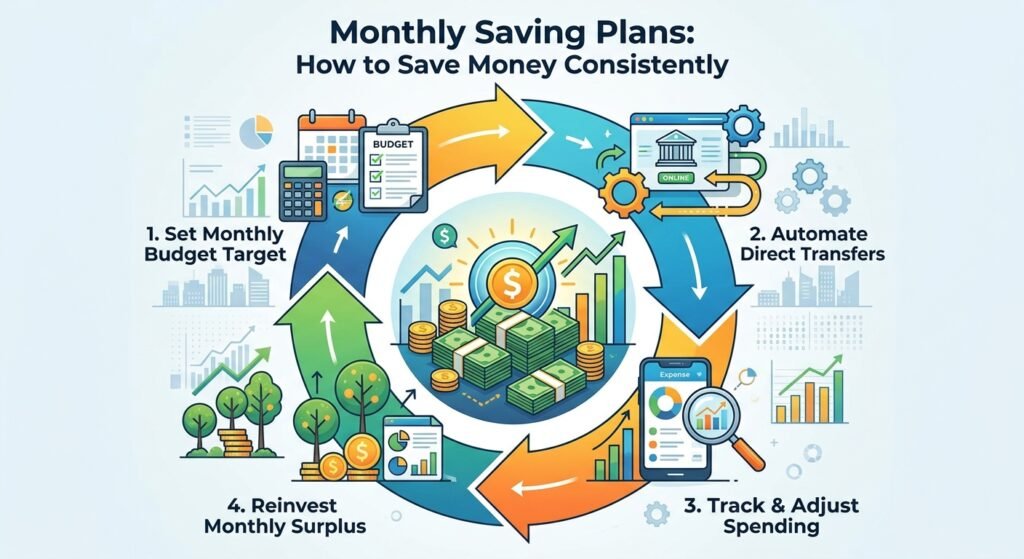
Monthly Saving Plans: How to Save Money Consistently
Saving money consistently is one of the most important habits you can develop for a stronger financial future. Many people understand that saving is important, but they struggle to save money regularly because of unexpected expenses, changing income, unnecessary spending, or a lack of financial planning. A monthly saving plan can make the process easier by giving your money a clear purpose and creating a consistent routine.
A monthly saving plan is a simple system that allows you to set aside a specific amount of money every month for future needs and financial goals. Instead of waiting until the end of the month to see whether any money is left, you decide in advance how much you want to save and make it part of your regular budget. With consistency and discipline, even small monthly savings can grow into a significant financial reserve over time.
Whether you are saving for an emergency fund, a home, education, a car, retirement, travel, or another personal goal, developing a structured monthly savings strategy can help you make steady progress. This guide explains how monthly saving plans work, how to choose a realistic savings target, how to automate your savings, how to reduce unnecessary expenses, and how to stay motivated over the long term.
What Is a Monthly Saving Plan?
A monthly saving plan is a financial strategy in which you set aside a predetermined amount of money every month. The money can be placed in a savings account, fixed-term deposit, or another appropriate financial product depending on your financial goal and circumstances.
The main purpose of a monthly saving plan is consistency. Instead of saving only when you have extra money, you make savings a regular part of your financial routine.
For example, if you decide to save $300 every month, you will contribute $3,600 over a year before considering any interest or investment returns. If your income changes, you can adjust the contribution while maintaining the habit.
A monthly saving plan can be simple. You do not need complicated financial software or advanced investment knowledge. A clear goal, realistic budget, and consistent contribution can provide a strong starting point.
Why Consistent Monthly Saving Matters
Consistency is one of the most important factors in building financial security. Saving a large amount once can be helpful, but regular contributions create a sustainable financial habit.
Monthly savings can help you prepare for planned expenses instead of relying on credit or loans. For example, if you know that your annual insurance payment is coming, you can divide the expected cost across twelve months and save a portion each month.
Regular saving can also create an emergency reserve. Unexpected expenses are easier to manage when you already have money set aside.
Over time, consistent saving can also help you move toward long-term financial goals. The amount you save may increase as your income grows, allowing your financial progress to accelerate.
Start by Setting a Monthly Savings Goal
The first step in creating a monthly saving plan is deciding how much you want to save each month. The amount should be realistic based on your income, expenses, debts, and financial goals.
A goal that is too ambitious may be difficult to maintain. On the other hand, a target that is too small may not provide enough progress toward your objectives.
Start by reviewing your monthly income and essential expenses. Calculate how much money remains after necessities such as housing, food, transportation, utilities, education, insurance, and debt payments.
From the remaining amount, determine a savings contribution that you can maintain comfortably.
Your monthly savings goal can also be connected to a specific target. For example, if you want to save $6,000 in one year, you would need to contribute approximately $500 per month before accounting for interest.
Create a Monthly Budget
A monthly budget is the foundation of a successful savings plan. It gives you a clear picture of where your money is going and helps you identify opportunities to save.
Begin by listing your monthly income. Then categorize your expenses into essential and discretionary spending.
Essential expenses include things you generally need to pay, such as housing, utilities, groceries, transportation, and required debt payments. Discretionary expenses may include entertainment, dining out, shopping, subscriptions, and other optional purchases.
Once you understand your spending patterns, you can determine where savings can be increased.
A budget does not have to eliminate all enjoyable spending. The goal is to create a balance that allows you to enjoy your income while still making consistent progress toward your financial goals.
Pay Yourself First
One effective approach to monthly saving is to “pay yourself first.” This means putting money into savings before spending on non-essential expenses.
When your salary or other income arrives, transfer your planned savings amount to a separate savings account. Then use the remaining money for your monthly expenses.
This method can make saving easier because you do not depend on whatever money happens to remain at the end of the month.
If you wait until the end of the month, unexpected purchases may consume the money you intended to save. Paying yourself first gives savings a higher priority.
Automate Your Monthly Savings
Automation is one of the easiest ways to save money consistently. Most banks and financial institutions provide options for automatic transfers between accounts.
You can schedule a transfer for the day your salary arrives or another convenient date. The money then moves automatically into your savings account.
For example, if your monthly savings goal is $250, you can set up an automatic transfer of $250 each month.
Automation reduces the need to remember to save and can help turn saving into a routine.
However, review your account balance before major automatic transfers and ensure that the amount is appropriate for your current financial situation.
Create Separate Savings Accounts
Keeping savings separate from everyday spending money can make it easier to avoid unnecessary withdrawals.
You could have one account for emergency savings and another for specific financial goals. Some banks also provide digital savings spaces or sub-accounts that allow you to organize money without opening multiple traditional accounts.
Separating savings helps you see how much money is available for each purpose.
For example, you might have a vacation fund, education fund, emergency fund, and home savings category.
Clear separation can also make financial progress more visible and motivating.
Build an Emergency Fund
An emergency fund should be an important part of a monthly savings strategy. It provides financial protection when unexpected expenses occur.
Emergencies may include medical expenses, urgent repairs, temporary loss of income, or other unexpected financial obligations.
The amount you need depends on your circumstances. People with unstable income or significant responsibilities may prefer a larger emergency reserve.
The emergency fund should generally be kept in a relatively safe and accessible account. Its purpose is financial protection rather than maximizing returns.
If you are starting from zero, do not worry about reaching a large target immediately. Begin with smaller monthly contributions and gradually increase them.
Reduce Unnecessary Monthly Expenses
One way to increase your monthly savings is to review your spending and identify expenses that provide limited value.
Look at recurring subscriptions, frequent restaurant meals, online shopping, entertainment expenses, delivery fees, and other discretionary purchases.
You do not necessarily need to eliminate everything. Instead, determine which expenses you can reduce without significantly affecting your quality of life.
For example, canceling an unused subscription and redirecting that amount toward savings can create a small but consistent improvement.
Small monthly savings can become significant when repeated for years.
Use the 24-Hour Rule for Purchases
Impulse purchases can interfere with monthly savings goals. One simple strategy is to wait before making non-essential purchases.
For smaller purchases, you might wait 24 hours before deciding. For expensive items, you could wait several days or weeks.
This gives you time to determine whether you genuinely need the item or simply want it because of a temporary impulse.
Money that you do not spend can be redirected toward your savings plan.
Save Unexpected Income
Unexpected income can provide an excellent opportunity to increase your savings without changing your normal monthly budget.
Examples may include bonuses, gifts, refunds, freelance income, or other additional earnings.
You do not have to save all unexpected income. You could divide it between savings, debt repayment, and personal spending.
For example, you might choose to put a portion of a bonus into your emergency fund and use the remainder for a planned purchase.
The key is to avoid automatically treating every additional amount of money as an opportunity to increase spending.
Increase Your Savings When Your Income Increases
When your salary or income increases, consider increasing your monthly savings contribution.
For example, if your monthly income increases by $300, you could direct part of that increase toward savings instead of spending the entire amount.
This approach can help prevent lifestyle inflation, where spending rises at the same rate as income.
Gradually increasing your savings can help you reach long-term goals more quickly without making dramatic changes to your lifestyle.
Monthly Saving Plans for Different Financial Goals
Different financial goals require different saving strategies. A monthly savings plan for an emergency fund may be different from a plan for retirement or a home purchase.
For short-term goals, focus on keeping money relatively safe and accessible. Traditional savings accounts or other suitable short-term products may be appropriate depending on your circumstances.
For medium-term goals, you may consider savings products with different maturity periods or a combination of savings and appropriate investments.
For long-term goals, such as retirement, you may have more flexibility to consider diversified investment strategies. However, investments carry risk, and their value can fluctuate.
Always match the financial product to the time frame and importance of your goal.
Understand Interest and Compound Growth
Interest can help your savings grow over time. If your savings account pays interest and you leave those earnings in the account, the balance can gradually increase.
Compound growth occurs when your accumulated earnings also generate future earnings.
For example, if you regularly contribute money and leave the interest in your account, your balance may grow through both new contributions and accumulated interest.
The impact of compounding generally becomes more noticeable over longer periods.
However, actual returns depend on the financial product, interest rate, fees, taxes, and other conditions.
Consider Inflation
Inflation can affect the purchasing power of your savings. When prices increase, the same amount of money may buy fewer goods and services.
For short-term savings, accessibility and stability may be more important than achieving high returns. For long-term goals, however, it is important to consider whether your savings strategy has the potential to keep pace with inflation.
Some people use a combination of cash savings and investments for long-term goals. Investments can provide greater growth potential but also involve market risk.
Understanding inflation can help you set more realistic savings targets.
Track Your Monthly Savings Progress
Tracking your progress can make saving more motivating. You can use a spreadsheet, budgeting app, banking tool, or simple notebook to record your contributions.
At the end of each month, compare your actual savings with your target.
If you planned to save $300 but saved $250, do not treat it as a failure. Instead, review why you fell short and determine whether you can adjust your spending or savings target.
Tracking also allows you to celebrate progress. Seeing your savings balance increase can encourage you to maintain the habit.
What to Do When You Cannot Save Your Target Amount
There may be months when you cannot save your normal amount. Unexpected expenses, reduced income, or other financial responsibilities can happen.
If this occurs, avoid abandoning your savings plan completely. Save whatever amount is realistically possible and return to your normal contribution when your financial situation improves.
You can also temporarily reduce discretionary spending to compensate for an unexpected expense.
The goal of a monthly savings plan is consistency over time, not perfection every single month.
Avoid Using Savings for Everyday Spending
A common problem is treating savings as an extension of your checking or everyday spending account.
If you regularly withdraw savings for restaurants, shopping, entertainment, or other routine expenses, your financial goals may take longer to achieve.
Keeping savings in a separate account can create a psychological barrier between spending money and goal-oriented money.
Before withdrawing savings, ask whether the expense is necessary and whether it is connected to the purpose of that particular fund.
Manage Debt Alongside Saving
Debt management should be considered alongside saving. High-interest debt can significantly affect your financial progress.
You may need to balance building an emergency fund with paying down expensive debt. The appropriate balance depends on your personal circumstances.
Maintaining at least some emergency savings can provide protection against unexpected expenses, while reducing high-cost debt can free up more money for future saving.
Create a plan that addresses both priorities rather than ignoring either one.
Common Monthly Saving Mistakes
One common mistake is setting an unrealistic monthly savings target. If you consistently save more than you can afford, you may eventually need to withdraw the money again.
Another mistake is failing to track spending. Without knowing where your money goes, it can be difficult to identify opportunities to save.
Ignoring small recurring expenses can also reduce your savings potential. Subscriptions and frequent discretionary purchases can add up over time.
Another mistake is keeping long-term savings entirely in cash without considering inflation or appropriate investment options. However, investments carry risks, so the right approach depends on your financial goal and timeline.
Finally, many people give up after missing a monthly target. A temporary setback does not have to end your savings journey.
How to Stay Motivated to Save Every Month
Motivation can make a significant difference in long-term financial habits. One way to stay motivated is to connect your savings to something meaningful.
Instead of thinking only about the money, think about what the money will help you achieve. Your savings could represent a future home, education, financial independence, travel, or greater emergency security.
Use visual progress trackers if they help you. Watching a savings goal move closer to completion can provide encouragement.
You can also celebrate milestones without spending excessively. Reaching your first major savings target can be an important achievement.
Create a Monthly Savings Routine
A consistent routine can make saving feel automatic. Choose a specific day each month to review your income, expenses, savings contributions, and financial goals.
Check your bank accounts and confirm that automatic transfers have occurred. Review your spending and identify areas where you can improve.
If your income or expenses have changed, adjust your savings amount.
This monthly review does not need to take a long time. Even a short financial check-in can help you stay organized.
Long-Term Benefits of Consistent Saving
Consistent monthly saving can provide several long-term benefits. It can help you build emergency reserves, reduce dependence on debt, achieve financial goals, and create a foundation for investing.
Over time, regular contributions can become substantial, particularly when combined with interest or investment returns where appropriate.
The biggest advantage may be the development of financial discipline. Once saving becomes a regular habit, managing money can become easier and more predictable.
Final Thoughts
A monthly saving plan is a practical way to develop financial discipline and make steady progress toward your goals. You do not need to save a huge amount every month to begin. The most important step is to choose a realistic amount and contribute consistently.
Start by understanding your income and expenses. Create a monthly budget, set a specific savings goal, and automate your contributions whenever possible. Keep emergency savings separate from everyday spending and consider creating different savings categories for different goals.
Review your progress regularly and increase your savings when your income grows. At the same time, manage debt, control unnecessary expenses, and consider inflation when planning for the long term.
Remember that saving money is a long-term process. Some months will be easier than others, and unexpected expenses may sometimes interrupt your progress. What matters is returning to your plan and continuing to save.
Whether you are saving your first $100, building an emergency fund, preparing for a major purchase, or working toward long-term financial security, saving money consistently every month can help you move closer to your financial goals. A simple plan followed regularly can become a powerful financial habit over time.